Fixed Indexed Annuities in Plain English
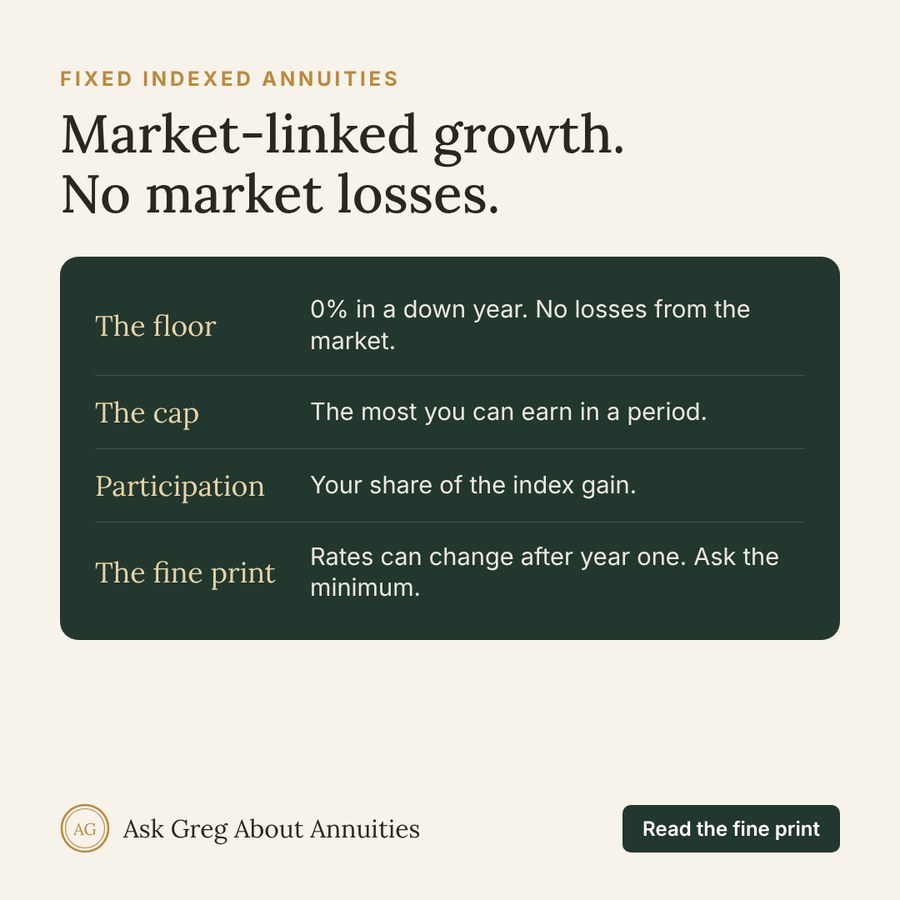
If someone has pitched you an annuity lately, there's a good chance it was a fixed indexed annuity. The promise sounds almost too good: growth linked to the stock market, with no losses when the market drops. Here's how it really works.
The basic idea
Your money isn't invested in the stock market. The insurance company credits interest based on how a market index, like the S&P 500, performs. When the index goes up, you earn part of that gain. When it goes down, you earn zero for that period. You don't lose money because of the market.
The floor: 0%
In a down year, your account value stays where it was. It doesn't go up, and it doesn't drop with the market. Gains you've already earned are locked in and can't be lost to a later downturn. This is the main reason people choose these.
Want to see how this applies to your money? I'll walk through your numbers on a free call, in plain English. Pick a time →
The trade-off: you don't get all of the upside
In exchange for that floor, your share of the gains is limited. The three common ways companies limit it:
- Cap. The most you can earn in a period. With a 9% cap, if the index gains 20%, you get 9%.
- Participation rate. The share of the gain you get. At 50%, a 20% gain credits 10%.
- Spread. A fee taken off the top of the gain. With a 3% spread, a 10% gain credits 7%.
Dividends usually aren't counted, either. So these products won't keep up with the stock market in strong years. They're not meant to. They're meant to do better than safe money in good years without the losses in bad ones.
Rates can change
This is the part people miss. The cap or participation rate you see at the start is often guaranteed only for the first year or first term. After that, the company can lower it, down to a contract minimum. Ask what the minimum is, and how the company has treated its existing customers' rates over time.
Illustrations aren't promises
You'll probably see a chart showing how the annuity "would have" done over past years. That's a hypothetical, based on assumptions that may not hold. Look at the guaranteed column too. That's the only part the company promises.
It's still a long-term contract
Fixed indexed annuities have surrender charges, often for 7 to 10 years. Many come with a bonus that has strings attached. And income riders, which guarantee a lifetime withdrawal amount, usually cost an extra yearly fee.
Who they tend to fit
People who want more growth potential than a CD or fixed annuity, can't stomach market losses, and won't need the money for the length of the surrender period. They're usually a poor fit for money you may need soon, or for someone comfortable riding out market swings.
Questions to ask before you buy
- What's the cap or participation rate, and how long is it guaranteed?
- What's the minimum it can ever drop to?
- How long is the surrender period, and what's the schedule?
- Are there any yearly fees, including for riders?
- What does the guaranteed column of the illustration show?
If you've been handed an illustration and want a second opinion, send it my way. I'll walk you through what it actually promises.
Have a question about your own numbers?
Book a free call of up to 30 minutes. I'll give you a straight answer in plain English, including when the best move is to leave things where they are.
Book a free callFree guide: 5 questions to ask before you buy any annuity
A two-page checklist you can print and bring to any annuity conversation, with room for notes. Enter your email and it's yours.
No spam. I'll send an occasional plain-English note, and you can unsubscribe anytime. Privacy policy.