Leaving Your School District? What to Do With Your 403(b)
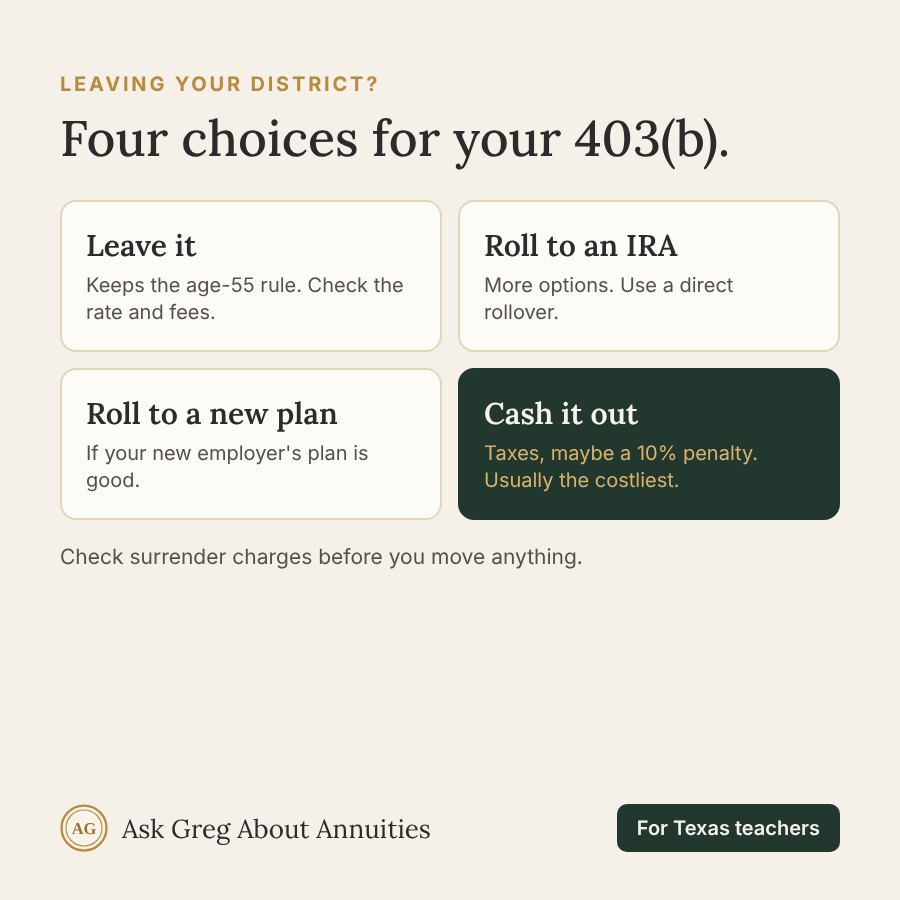
Short answer: once you leave the district, you can usually leave your 403(b) where it is, roll it into an IRA, roll it into a new employer's plan, or cash it out. A direct rollover keeps it tax-deferred. Cashing out is almost always the most expensive choice.
When you can move it
You can generally move your 403(b) after you separate from the district. Many plans also let you move money at age 59½ even while you're still teaching. Plan rules vary, so check yours.
Five mistakes that cost teachers money
- Ignoring surrender charges. Many Texas 403(b)s are annuities. If yours is still in its surrender period, moving it early can cost you. Get the schedule first.
- Taking a check instead of a direct rollover. A check paid to you triggers 20% federal withholding. A direct rollover from company to company avoids it.
- Losing the age-55 rule. If you leave the district in or after the year you turn 55, you can take money from that 403(b) without the 10% early-withdrawal penalty. Roll it into an IRA and that break goes away until 59½. If you'll need the money before then, keep at least part of it in the 403(b).
- Forgetting an outstanding loan. An unpaid 403(b) loan can become a taxable distribution when you leave. Deal with it before you move the money.
- Leaving old accounts scattered. Teachers who changed districts often have small 403(b)s in several places. Pulling them together makes them easier to manage, and easier to handle when required withdrawals start at 73 (75 if you were born in 1960 or later).
Not sure what to do with yours? Send me your latest statement and I'll give you a straight read on a free call. Pick a time →
When moving makes sense
It's often worth moving if your account is past its surrender period and stuck at a low minimum rate, if it charges high fees, or if you want options it doesn't offer, like guaranteed lifetime income.
When leaving it alone is smarter
If your 403(b) has a strong guaranteed rate, if you're still inside the surrender period, or if you'll rely on the age-55 rule, staying put can be the better move. Sometimes the best advice really is leave it where it is.
Don't forget the 457
If your district offered a 457(b), it has its own advantage: after you leave the district, withdrawals from a governmental 457(b) have no 10% early-withdrawal penalty at any age. That makes it a useful bridge if you retire before 59½.
General information, not tax advice. Rules depend on your plan and situation; confirm with your plan administrator or tax professional.
Have a question about your own numbers?
Book a free call of up to 30 minutes. I'll give you a straight answer in plain English, including when the best move is to leave things where they are.
Book a free callFree guide: 5 questions to ask before you buy any annuity
A two-page checklist you can print and bring to any annuity conversation, with room for notes. Enter your email and it's yours.
No spam. I'll send an occasional plain-English note, and you can unsubscribe anytime. Privacy policy.