How Annuities Are Taxed, in Plain English
"Tax-deferred" is one of the first things people hear about annuities. It's a real benefit. It also raises the obvious question: deferred until when? Here's how it works.
While your money grows, you owe nothing
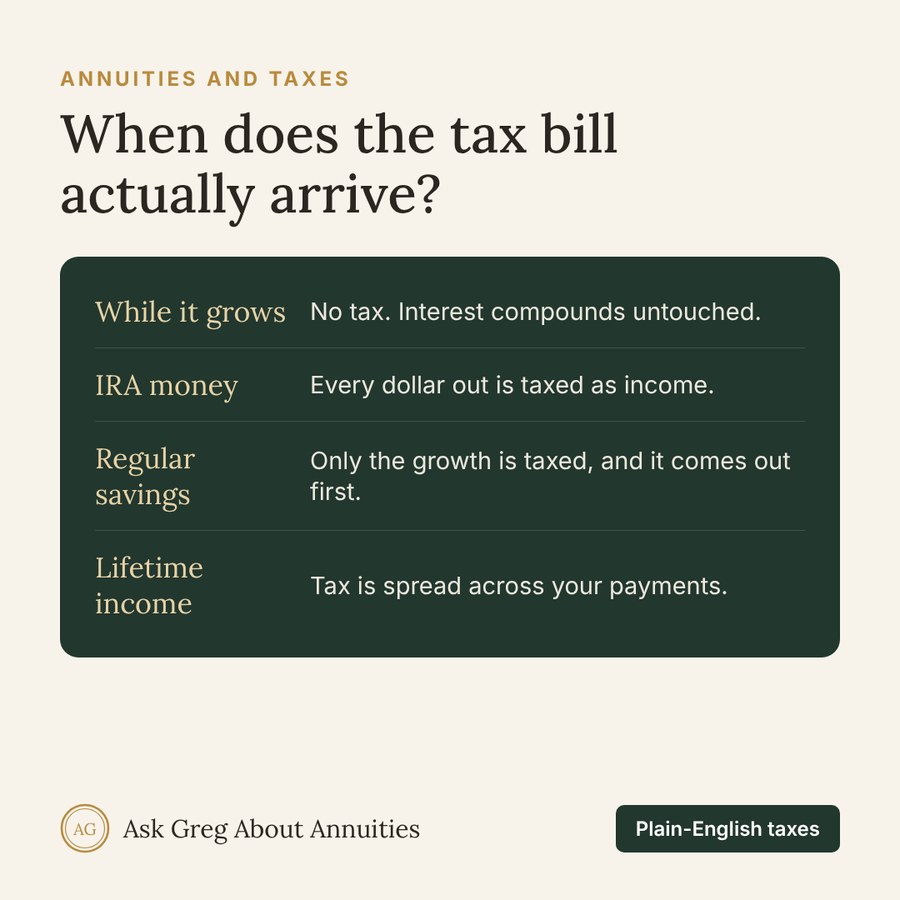
Interest inside an annuity isn't taxed year by year. A bank CD sends you a 1099 every January, even if you never touch the interest. An annuity doesn't. Your money compounds on the full amount, and taxes wait until you take money out.
The one detail that changes everything: where the money came from
IRA or 401(k) money (called "qualified"). If you buy an annuity inside an IRA, or roll a 401(k) into one, you never paid tax on that money. So every dollar you take out is taxed as ordinary income, the same as any IRA withdrawal. The annuity doesn't add any extra tax benefit here. People choose it for the guarantees, not the tax treatment.
Regular savings (called "non-qualified"). If you buy an annuity with money you already paid tax on, like a CD or a savings account, only the growth is taxed. The money you put in comes back to you tax-free.
Want to see how this applies to your money? I'll walk through your numbers on a free call, in plain English. Pick a time →
What comes out first
With a non-qualified annuity, the IRS treats withdrawals as growth first. Say you put in $100,000 and it grows to $130,000. The first $30,000 you take out is taxed as ordinary income. After that, you're getting your own $100,000 back, and that part isn't taxed.
If you turn the annuity into a lifetime income stream, the math changes in your favor. Each payment is split into part growth (taxed) and part return of your own money (not taxed), so the tax is spread out over the years.
The age 59½ rule
Take growth out before age 59½ and the IRS usually adds a 10% penalty on top of the income tax. Since most of the people I work with are near or in retirement, this rarely comes up. It's still worth knowing.
What your family owes
When you pass away, your beneficiaries owe income tax on any growth that hasn't been taxed yet. Unlike stocks or a house, an annuity doesn't get a "step-up" that wipes out the gain. That's one reason an annuity isn't always the best place for money you mainly plan to leave to your kids.
Required minimum distributions
If the annuity is inside an IRA, required minimum distributions still apply, starting at age 73 for most people today. Most annuity companies can calculate and send your RMD for you. A non-qualified annuity has no RMDs.
The short version
- Growth isn't taxed until you take it out.
- IRA money: everything you take out is taxable, same as any IRA.
- Regular savings: only the growth is taxed, and growth comes out first.
- Lifetime income spreads the tax out over your payments.
- Heirs pay tax on untaxed growth.
Taxes are personal, and I'm not a tax advisor, so check the details with your CPA before you act. What I can do is show you how a specific annuity's withdrawals would look, year by year, so you can bring real numbers to that conversation.
Have a question about your own numbers?
Book a free call of up to 30 minutes. I'll give you a straight answer in plain English, including when the best move is to leave things where they are.
Book a free callFree guide: 5 questions to ask before you buy any annuity
A two-page checklist you can print and bring to any annuity conversation, with room for notes. Enter your email and it's yours.
No spam. I'll send an occasional plain-English note, and you can unsubscribe anytime. Privacy policy.