The Most Useful Retirement Number: Your Income Gap
Most people measure retirement readiness by their account balance. The more useful number is your monthly income gap: how much of your spending isn't covered by income you can count on.
Find it in three steps
- Add up your monthly spending in retirement: housing, food, insurance, health care, travel, all of it.
- Subtract your steady income: Social Security, any pension, rental income, anything that arrives every month regardless of the market.
- What's left is your gap. That's what your savings have to cover, every month, for as long as you live.
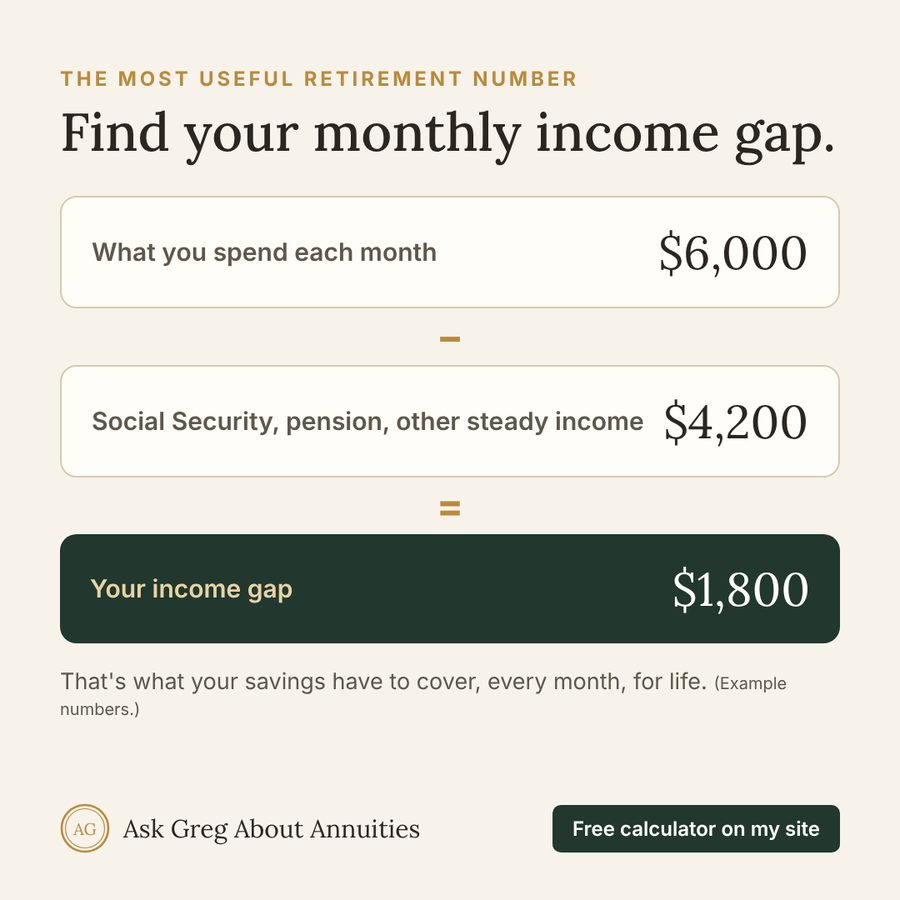
For example, if you'll spend $6,000 a month and Social Security brings in $4,200, your gap is $1,800 a month.
Want to see how this applies to your money? I'll walk through your numbers on a free call, in plain English. Pick a time →
Why it makes decisions easier
- It tells you how hard your savings have to work, and how exposed you are to a bad market early in retirement.
- It shows whether delaying Social Security, which raises your steady income, would close much of the gap.
- It helps you decide whether turning part of your savings into guaranteed income makes sense, and how much.
I built a free income gap calculator that does the math for you in about two minutes.
Have a question about your own numbers?
Book a free call of up to 30 minutes. I'll give you a straight answer in plain English, including when the best move is to leave things where they are.
Book a free callFree guide: 5 questions to ask before you buy any annuity
A two-page checklist you can print and bring to any annuity conversation, with room for notes. Enter your email and it's yours.
No spam. I'll send an occasional plain-English note, and you can unsubscribe anytime. Privacy policy.