Retired and Worried About Running Out of Money? Start Here.
"Am I going to run out of money?" It's the question I hear most from people who are already retired. If you've saved somewhere between $250,000 and $500,000, the honest answer is: it depends far more on how you use that money than on the exact amount.
Here's how to get a clear answer, and what to do if you don't like it.
Withdrawals matter most
The single biggest factor is how much you take out each year. Small changes make a big difference over a 20- or 30-year retirement.
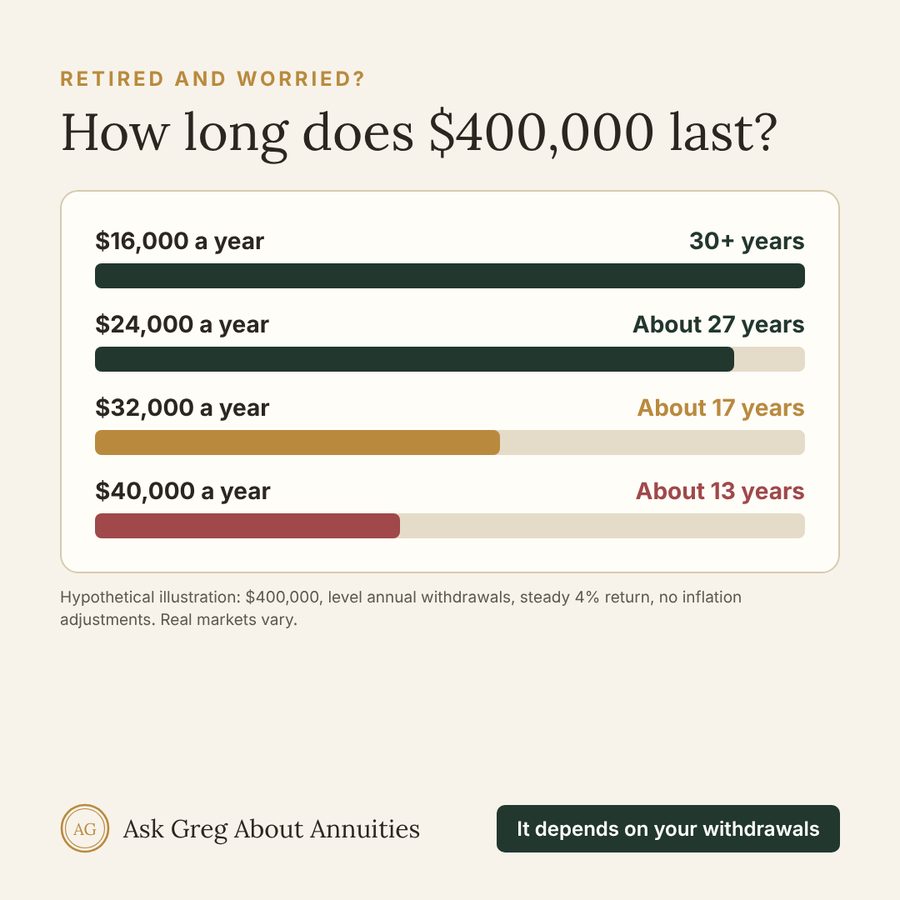
In this simple example, taking $24,000 a year from $400,000 lasts about 27 years. Bump it to $32,000 and it's closer to 17. Real life adds market swings and rising prices, so the actual answer for you needs your own numbers. The pattern holds, though: a modest cut in withdrawals can add many years.
Step 1: Find your monthly income gap
Add up what you spend each month, then subtract the income you can count on: Social Security, any pension, rental income. What's left is the gap your savings have to fill. My income gap calculator does the math, and this article walks through it.
A smaller gap means less pressure on your savings, and less worry.
Want to see how this applies to your money? I'll walk through your numbers on a free call, in plain English. Pick a time →
Step 2: Protect against a bad market early on
If the market drops while you're withdrawing, you sell more shares at low prices, and that damage is hard to undo. It's called sequence-of-returns risk, and it's one of the main reasons retirees run short. Keeping one to two years of spending in cash or fixed accounts means you're not forced to sell during a downturn.
Step 3: Cover the essentials with guaranteed income
Many people sleep better when their must-pay bills (housing, food, insurance, utilities) are covered by income that keeps coming no matter what the market does. Social Security is the foundation. Some people use a portion of their savings to buy an income annuity, which pays a set amount every month for life. That turns part of your savings into a paycheck you can't outlive.
It isn't right for everyone, and it shouldn't be all of your money. For some people, though, guaranteeing the basics is what finally ends the worry.
Step 4: Build in flexibility
- Spend a little less in down years and a little more in good ones. Flexible spending is one of the most powerful ways to make savings last.
- Watch fees. Paying 1.5% to 2% a year in fees on a few hundred thousand dollars adds up to tens of thousands over a retirement.
- Plan for health care and required withdrawals. Medicare premiums, out-of-pocket costs, and required minimum distributions from IRAs (starting at age 73) all affect how much you actually have to spend.
The bottom line
Worrying about running out of money is common, and it's usually a sign that you need a plan, not that you're in trouble. Once you know your income gap and your sustainable withdrawal amount, you can decide how much needs to be guaranteed and how much can stay flexible.
Have a question about your own numbers?
Book a free call of up to 30 minutes. I'll give you a straight answer in plain English, including when the best move is to leave things where they are.
Book a free callFree guide: 5 questions to ask before you buy any annuity
A two-page checklist you can print and bring to any annuity conversation, with room for notes. Enter your email and it's yours.
No spam. I'll send an occasional plain-English note, and you can unsubscribe anytime. Privacy policy.