Retired With Modest Savings and Not Sure Where to Start?
If you're already retired, have less than $100,000 saved, and don't know where to start, you're far from alone. Most Americans retire with modest savings. The good news is that the first steps don't require a complicated plan or a big account. They just need to happen in the right order.
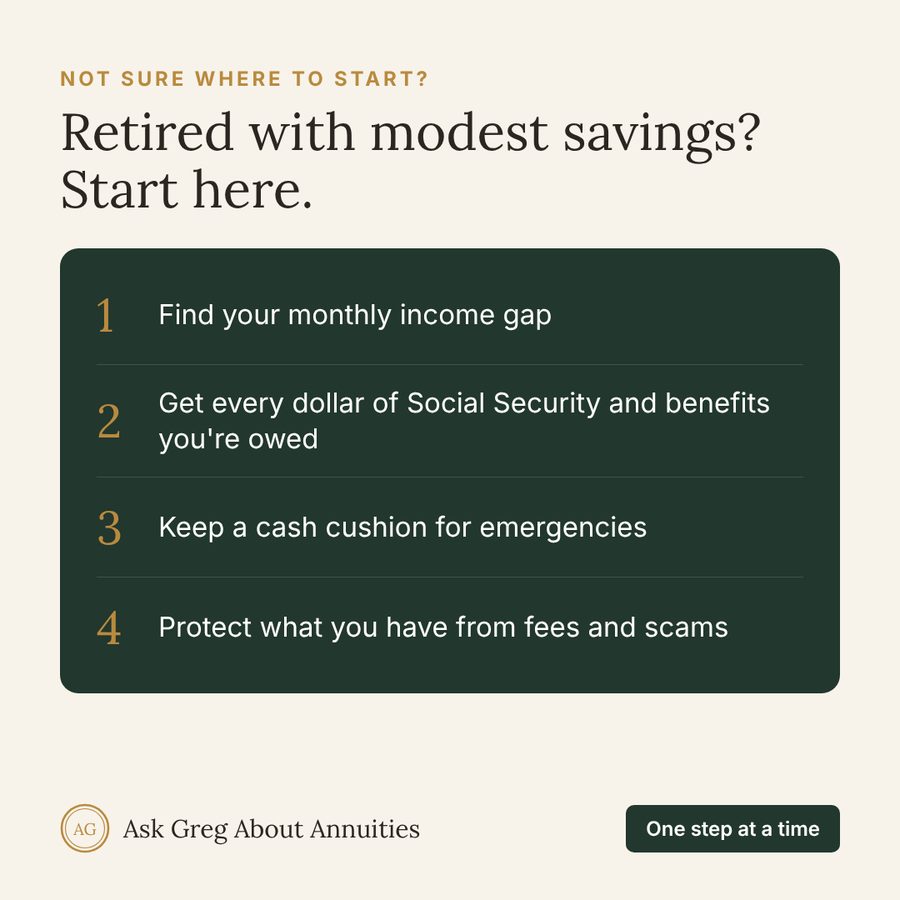
1. Find your monthly income gap
Write down what comes in every month (Social Security, any pension, part-time work) and what goes out. The difference is your gap. If your income already covers your bills, your savings are your safety net, and protecting them is the priority. If there's a shortfall, you'll know exactly how much your savings need to cover. My free income gap calculator can help.
2. Make sure you're getting every dollar you're owed
- Social Security: if you haven't claimed yet, waiting even a year or two raises your check for life, up to age 70. If you're married, the timing of each spouse's claim matters, especially for survivor benefits.
- Help with health care costs: Medicare Savings Programs can pay your Part B premium, and the Extra Help program lowers prescription costs. Many people who qualify never apply.
- Other benefits: the free BenefitsCheckUp tool from the National Council on Aging (benefitscheckup.org) checks you against thousands of programs for things like food, utilities and property taxes.
Want to see how this applies to your money? I'll walk through your numbers on a free call, in plain English. Pick a time →
3. Keep a cash cushion
With modest savings, flexibility matters more than return. Keep enough in a high-yield savings or money market account to handle a car repair, a medical bill or a new roof without panic. For many retirees that's three to six months of expenses, or more if your income barely covers your bills.
4. Protect what you have
- Watch out for high fees on investment accounts or products. On a smaller balance, fees take a bigger bite.
- Be wary of anyone who pressures you to move all of your money, especially into something you can't easily get out of.
- Scams target retirees. Government agencies won't call you demanding payment, and a legitimate advisor will never ask for gift cards or a wire to "protect" your money.
Where an annuity fits, and where it doesn't
With under $100,000, locking most of your money into an annuity usually isn't the right move. You need it accessible. Sometimes, though, a small, safe piece can make sense. For example, a multi-year guaranteed annuity (MYGA) can pay a fixed rate on money you're sure you won't touch for a few years, often more than a bank CD. The key word is small. Your cushion comes first.
And sometimes the best advice is to leave things where they are.
You don't have to figure it out alone
A single conversation can sort out your income, your benefits and what to do with what you've saved. It doesn't cost anything and doesn't commit you to anything.
Have a question about your own numbers?
Book a free call of up to 30 minutes. I'll give you a straight answer in plain English, including when the best move is to leave things where they are.
Book a free callFree guide: 5 questions to ask before you buy any annuity
A two-page checklist you can print and bring to any annuity conversation, with room for notes. Enter your email and it's yours.
No spam. I'll send an occasional plain-English note, and you can unsubscribe anytime. Privacy policy.