How Sequence of Returns Shapes Your Retirement Income
Most retirement planning focuses on one question: what average return will I earn? For anyone living off their savings, a second question matters just as much: in what order will those returns arrive?
That's sequence-of-returns risk. It doesn't just change your account balance. It changes how much income your savings can safely give you.
Same returns, very different income
Take $500,000 and 30 years of retirement. Give two retirees the exact same 30 annual returns, averaging about 5.6% a year. The only difference is the order. Then ask how much each one can withdraw every year without running out of money.
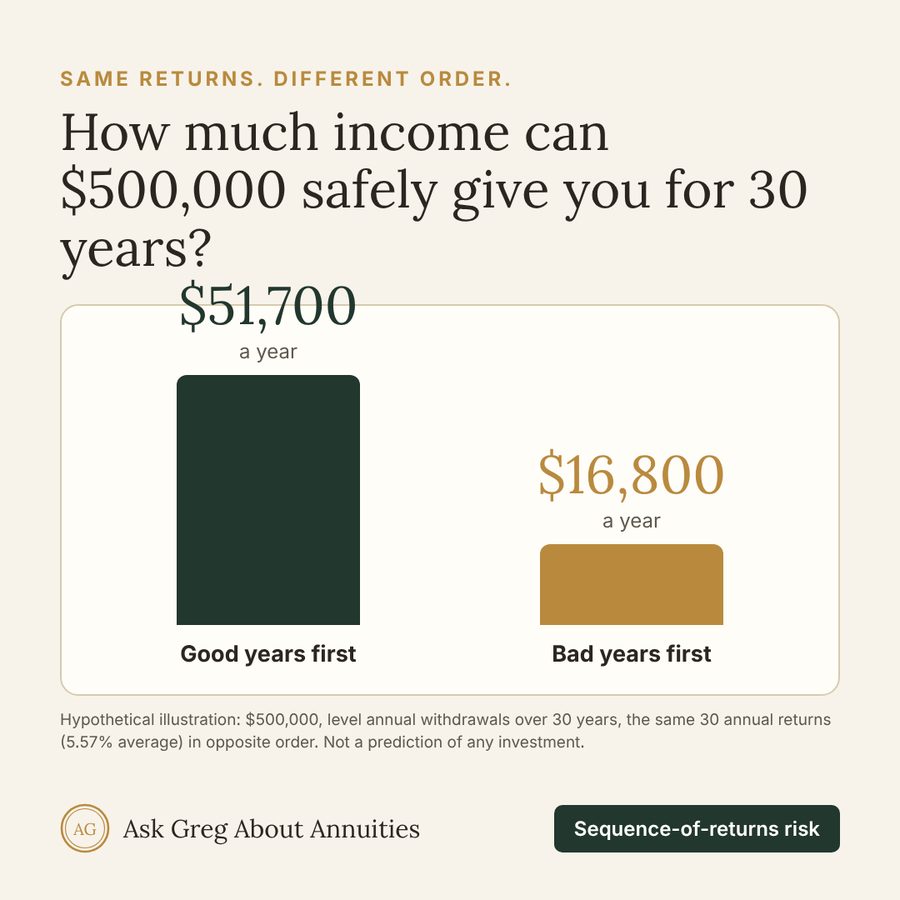
- Good years first: about $51,700 a year for 30 years.
- Bad years first: about $16,800 a year. Anything more and the money runs out early.
Same savings. Same average return. One retiree can safely spend about three times as much as the other, purely because of timing. This example is deliberately simple, with level withdrawals and no inflation adjustments, and the pattern holds in more detailed models too.
Why withdrawals make it worse
While you're working and adding money, a market drop is painful and temporary. You keep buying, and the recovery lifts everything.
In retirement, the math flips. When the market falls and you're still taking out the same income, you're selling more shares at lower prices to cover each month's bills. Those shares are gone for good. When the market recovers, there's less left to recover. A loss in year two can do more lasting damage than the same loss in year twenty-two.
Want to see how this applies to your money? I'll walk through your numbers on a free call, in plain English. Pick a time →
It does happen
This isn't just theory. People who retired at the start of 2000 watched the S&P 500 fall three years in a row. People who retired in 2007 saw it drop about 37% in 2008 alone. Retirees who kept withdrawing the same amount through those stretches often had to cut their spending sharply later on, even though markets eventually recovered.
The years just before and just after you retire are the danger zone. Nobody can predict which years will be good or bad, so the goal is a plan that holds up either way.
What people do about it
- Build an income floor. Cover your essential bills with income that doesn't depend on the market: Social Security, a pension, or a guaranteed income annuity. Then a bad market doesn't force you to sell at the bottom to pay for groceries.
- Keep a cash cushion. One to two years of spending in cash or short-term savings gives you something to draw from while the market recovers.
- Stay flexible. Trimming spending a little in down years, and allowing raises in good years, helps savings last much longer.
- Consider delaying Social Security. Each year you wait (up to age 70) raises your guaranteed lifetime income, which shrinks how much your savings have to cover.
- Protect the money you'll need first. Money earmarked for the first several years of retirement doesn't need to ride the market. Fixed options, including a MYGA, can lock in a known return for that stretch.
Where to start
The first step is finding your monthly income gap: how much of your spending isn't already covered by steady income. The bigger that gap, the more exposed you are to sequence risk, and the more an income floor can help.
For a simpler two-retiree version of this example, see Why Retiring Into a Down Market Is So Risky.
Have a question about your own numbers?
Book a free call of up to 30 minutes. I'll give you a straight answer in plain English, including when the best move is to leave things where they are.
Book a free callFree guide: 5 questions to ask before you buy any annuity
A two-page checklist you can print and bring to any annuity conversation, with room for notes. Enter your email and it's yours.
No spam. I'll send an occasional plain-English note, and you can unsubscribe anytime. Privacy policy.