Income Riders, Explained in Plain English
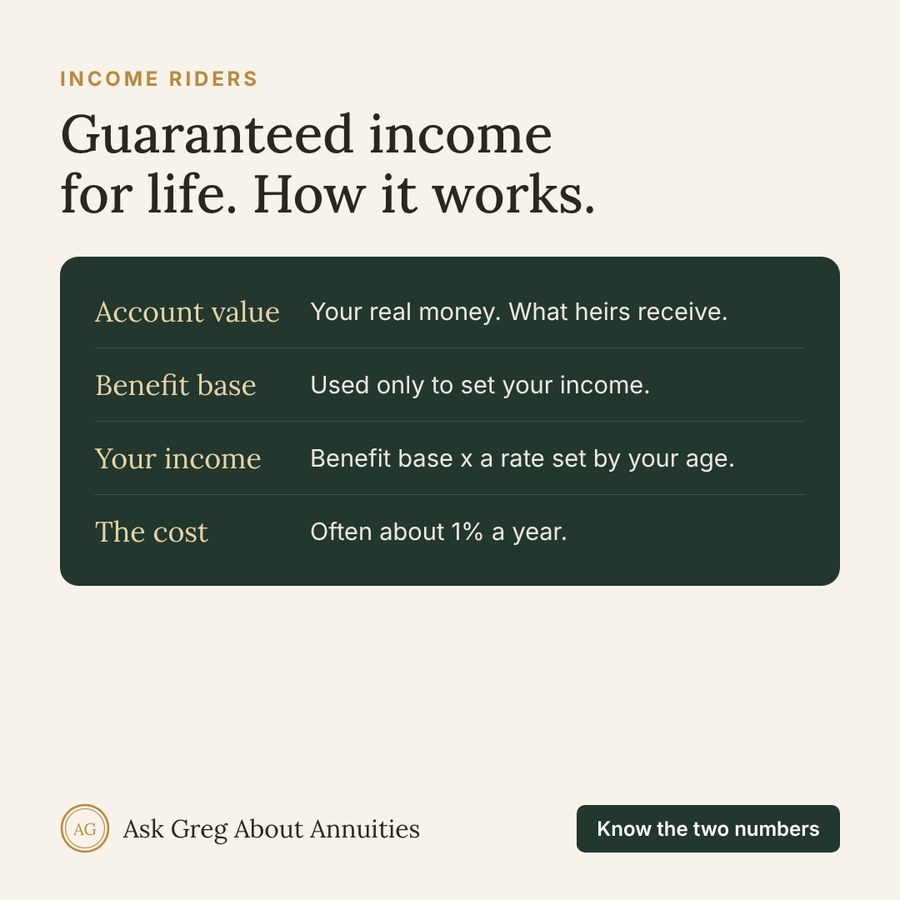
Many annuities can come with an income rider, often called a guaranteed lifetime withdrawal benefit. The promise: a set amount of income every year for the rest of your life, even if your account runs dry. That promise is real. How it works is worth understanding before you pay for it.
Two numbers, not one
An annuity with an income rider tracks two values:
- Your account value. The real money. It's what you could withdraw or leave to your family.
- The benefit base. A separate number used only to calculate your lifetime income. You can't cash it out.
This is the part people most often misunderstand. When you see a benefit base growing at 6% or 7% a year, that is not your money growing at 6% or 7%. It's the number your income will be based on.
How your income is set
When you turn on the income, the company multiplies the benefit base by a withdrawal percentage based on your age. For example, 5% at 65 on a $300,000 benefit base would be $15,000 a year, for life. Start later and the percentage is usually higher. Some riders pay less if you're married and want the income to last for both of your lifetimes.
Want to see how this applies to your money? I'll walk through your numbers on a free call, in plain English. Pick a time →
What happens when the account runs out
This is the point of the rider. Your yearly withdrawals come out of your account value. If the account eventually hits zero, the insurance company keeps paying the same income for as long as you live. You're buying protection against living a long time.
What it costs
Income riders usually charge a yearly fee, often around 1% of the benefit base, taken out of your account value. Over 10 or 20 years that adds up, and it lowers what's left for your heirs. Some products build the rider in at no separate fee, with lower growth potential instead.
What your family gets
If you pass away, your beneficiaries generally receive what's left of the account value, not the benefit base. If you've been taking income for years, that may be much less than the benefit base on your statement.
Rules that matter
- Take more than your guaranteed amount in a year, and your future income usually drops.
- The roll-up often stops once you start income, or after a set number of years.
- The surrender period still applies to the account value.
Who it tends to fit
People who want a guaranteed paycheck to cover essential bills, who are worried about outliving their money, and who care more about lifetime income than about leaving the largest possible amount to their kids. It's often a poor fit if you don't plan to use the income, since you'd be paying for a benefit you never collect.
If you've been shown an income rider illustration, I'm happy to walk through what the numbers actually mean for you.
Have a question about your own numbers?
Book a free call of up to 30 minutes. I'll give you a straight answer in plain English, including when the best move is to leave things where they are.
Book a free callFree guide: 5 questions to ask before you buy any annuity
A two-page checklist you can print and bring to any annuity conversation, with room for notes. Enter your email and it's yours.
No spam. I'll send an occasional plain-English note, and you can unsubscribe anytime. Privacy policy.